When I think of Hoosierweight Boxing, I think of one word: backyard.
I'm always filled with such a sense of sadness that I missed those early fights in Steve's backyard, in Roberto's. The idea of those fights fills me with this sense of what this city should be, and oddly, it always has. You wanna talk about a good show-- Steve gets it. The man puts on a good show.
Much of that has carried over into the Royale, and I understand I speak with a great amount of bias here. But when I look at the Royale, we have recreated a similar type of space, one where all the disparate elements of a place come together and fit somehow seemlessly, enriching the view. Last night was a good example. Friday night: the grill's lit up outside, the belly dancers were in doing their thing, the potholder people were there selling their crafts. It's a strange restaurant-cum-open air market with entertainment, almost more like a fairway or a street carnival. The mix of people at times makes me think of some strange futuristic Gibson novel where everything just blends, yet individuals remain somehow distinct. And I think it's somehow significant that this all goes down in what happens to be Steve's backyard, even if the Royale sign is out front.
That's why I have always loved the backyard fights: they're organic. They grew out of Steve's ideas, out of the fighters' enthusiasm, out of audience comments. They grew from a sense of desire and urgency, from a whimsey and a love. Everything that happened was about doing something differently and having a good time. And Steve is hitting that idea again, gloves flyin'.
On August 12, at midnight, Steve is throwing a round robin night of fights at the Panda. And I love the Panda. I love that Steven used to have a chicken there and would make the kids chase it. I love his office with the glass window, the espresso machine and the booze. I love watching the kids work and the coaches do what they are clearly so good at. I don't box, but I love all that the Panda is... especially the loading dock off the back. And so, fittingly, in August when it's hotter than hot anyway, Steve is having some folks over for a bit of sparring. These are not title fights. These are not even judged fights. But it's boxing, in all the glory of what it used to be in the backyard. It's boxing in all the spirit of why people do it and why people want to watch.
Last night, I got a strange preview. 2:15 am and Don, "Pride of the Southside" Beasley was moppin' the floors. I was washing glasses. The other usual suspects were doing dishes, cleaning the bathrooms, taking out the trash, and before I knew it, a challenge was leveled. Steven, on his way out the door, hat on and Caddy ready, stops to meet Don's challenge of wrestling. I called to Sarah and as we watched Steve and Don wrestle, alternately laughing, cheering, and cringing when they came close to furniture, I felt that same sense of thrill. There's something exciting about things just happening. There's something exciting about having someone to root for. And there's a strange sense of community about bearing witness to the spectacle. I'm not going to say who won, nor will I repeat any of the comments that the ragtag group of viewers yelled during the grappling, but I will say that it made me want to go sweat in the heat at the Panda and see that sparring on the 12th... and it made me wish that Steve's backyard would one day hold a fight again.
Saturday, July 29, 2006

Wednesday, July 26, 2006
Call to Order
In Birmingham, in 1963, it was the children who really made the nation take notice of Civil Rights. King tried to organize the city, but the adults, even disenfranchised, had too much to lose and feared the repercussions of demonstrating. It was the children of Birmingham, organized by an aide of MLK, who were called to demonstrate by the coded messages of a DJ over the airwaves. It was the kids who truly befuddled the authorities with their persistence and strength; it was them who went to "jail" by the hundreds, held in the livestock quarters of the fairground stockyards when the jails became full. It was them who stayed, resilient, for days and days, some as young as three or four. The image of those kids standing up for what they deserved was what truly catapulted the nation into outrage and paved the way for Civil Rights action.
And yet, when do we hear about this? Our history books conceal it; our collective consciousness either does not remember, or care, or understand the magnitude of this event. But I tell my students this story, ordinary school kids on the North side, and they sit, spellbound, reading the first person accounts of this event. It's one of my favorite lessons. I love it because they begin to feel the power they have. I tell them so they use that power. It's like what Malcolm X said, those that can vote in a bloc and choose not to wield that power, are truly sick.
We forget that the people most ignored have the capacity to have the greatest amount of power. They just have the least amount of resources to harness that power. Some like it like that. Some would have us keep it that way.
So, I've been thinking the last few weeks, and now I am wondering if it's like Malcolm X said: are we sick? Are we lazy? Or are we, as I hope, either like those children, unaware of our power... or like those voting blocs, too disorganized to wield our power?
This is what I have in mind: revolution.
I call it our renaissance, our rebirth into what we should be, what we want, what we know somehow we are capable of as a city.
I noticed today, driving through Tower Grove Park, that all the debris from the storm last week was cleared to the side of the roads, waiting for removal. Something about that struck me. The city in such disarray and upheaval, yet people were out on the street immediately when the storm passed, cleaning. Now, those neat piles of things cast to the side are our reminders. Out with the old: move on. Can we take that premise and work with it? Can we cast aside what doesn't work anymore to clear the way for a new vision?
I was just reading a huge national report of giving. In 2005, over $93 billion was given to religious charities in the US-- more than two times the amount given to education, more than four times the amount given to healthcare. I realize that religious organizations like the Salvation Army or Catholic Charities do social work and run several programs within these other categories, but do we give to religious charities because we believe so strongly in the religious aspect (and undoubtedly, for many, that answer would be yes), or do we give to the Salvation Army because we understand how organized they are and that they have the welfare of the people at heart?
Reading on, there was a profile of Rick Warren, author of The Purpose Driven Life. He was quoted as saying, "Reformation always starts with the peasants; they don't start with the elites." As inarticulate as his wording was, point taken. He then sited the "armies" of faith-based volunteers the world over, saying that in every village in the world, there is a church.
It reminded me of one of the best marketing models I have ever seen. Chicken Soup For the Soul. Nope, I've never read it, but I am well aware of its legacy in the publishing world. This little wisdom nugget book began as a self-published deal by the authors-- small-scale, small time, but with big dreams. They packed several hundred copies in the trunk of their car and began driving the country, dropping off copies in churches, creating the buzz, and the eventual demand that sold millions of copies and made it one of the hugest (and only) non-corporate publishing successes. They now have a Chicken Soup empire.
Wow.
So when I think about this-- and I'm not religious-- but there's something to be learned here. We need to look at what it is that pulls all these people together. I don't think it's as simple as just God, but there's definitely something about creating a community to belong to and about a common identified purpose. Across all these Christian faiths in America, there's a pulling together, a lack of competition (to some degree), a common goal, and a HUGE network of shared resources. Why do you think the religious right is so hated? They figured out the power, people.
Don't we have some of those same characteristics in STL? Many of us are on the front every day trying to do those same things in our own way: trying to build up neighborhoods (like Tension Head and artist Lindsey Scott on Cherokee), providing community arts resources (SCOSAG, Mad Art, KDHX), bringing people together to think (the Arch City Chronicle, CommonSpace), and running businesses that contribute to the community (MoKaBe's, the Royale, Mangia). Etc. Etc. The list goes on and on-- those are just quick ones from the top of my head and people I know. Add in all the writers, the bands, photographers, artists, non-profits, groups, neighborhood associations... and it's an army, people. Our army to do our own work.
I can only assume we all want a safe place to live, one cultivated in beauty and character and culled from diversity and innovation. I know it's not simple. The problem is creating a common culture is long-established and we have been trying to figure it out as Americans for centuries. But everyday, we create common desires, common identities, and common goals in small ways-- why not something more? How about simply, we all work together, each of us in our own way, to make this city better? But, how about we do it by forming an organization that can exist as a power in this city?
So, I ask: am I the only one who wants this?
My idea: start a South Side Arts Coalition: civic-minded, politically active, community focused and arts driven. If you're in, let me know.
Besides a church in every village, on every street on the South Side, there are people creating a better vision for this city: non-profit workers, small business owners, community activists, artists, and kids who want to be all of the above. Let's see if we can't do something together. We have our army; I'd like to start mobilizing.
And yet, when do we hear about this? Our history books conceal it; our collective consciousness either does not remember, or care, or understand the magnitude of this event. But I tell my students this story, ordinary school kids on the North side, and they sit, spellbound, reading the first person accounts of this event. It's one of my favorite lessons. I love it because they begin to feel the power they have. I tell them so they use that power. It's like what Malcolm X said, those that can vote in a bloc and choose not to wield that power, are truly sick.
We forget that the people most ignored have the capacity to have the greatest amount of power. They just have the least amount of resources to harness that power. Some like it like that. Some would have us keep it that way.
So, I've been thinking the last few weeks, and now I am wondering if it's like Malcolm X said: are we sick? Are we lazy? Or are we, as I hope, either like those children, unaware of our power... or like those voting blocs, too disorganized to wield our power?
This is what I have in mind: revolution.
I call it our renaissance, our rebirth into what we should be, what we want, what we know somehow we are capable of as a city.
I noticed today, driving through Tower Grove Park, that all the debris from the storm last week was cleared to the side of the roads, waiting for removal. Something about that struck me. The city in such disarray and upheaval, yet people were out on the street immediately when the storm passed, cleaning. Now, those neat piles of things cast to the side are our reminders. Out with the old: move on. Can we take that premise and work with it? Can we cast aside what doesn't work anymore to clear the way for a new vision?
I was just reading a huge national report of giving. In 2005, over $93 billion was given to religious charities in the US-- more than two times the amount given to education, more than four times the amount given to healthcare. I realize that religious organizations like the Salvation Army or Catholic Charities do social work and run several programs within these other categories, but do we give to religious charities because we believe so strongly in the religious aspect (and undoubtedly, for many, that answer would be yes), or do we give to the Salvation Army because we understand how organized they are and that they have the welfare of the people at heart?
Reading on, there was a profile of Rick Warren, author of The Purpose Driven Life. He was quoted as saying, "Reformation always starts with the peasants; they don't start with the elites." As inarticulate as his wording was, point taken. He then sited the "armies" of faith-based volunteers the world over, saying that in every village in the world, there is a church.
It reminded me of one of the best marketing models I have ever seen. Chicken Soup For the Soul. Nope, I've never read it, but I am well aware of its legacy in the publishing world. This little wisdom nugget book began as a self-published deal by the authors-- small-scale, small time, but with big dreams. They packed several hundred copies in the trunk of their car and began driving the country, dropping off copies in churches, creating the buzz, and the eventual demand that sold millions of copies and made it one of the hugest (and only) non-corporate publishing successes. They now have a Chicken Soup empire.
Wow.
So when I think about this-- and I'm not religious-- but there's something to be learned here. We need to look at what it is that pulls all these people together. I don't think it's as simple as just God, but there's definitely something about creating a community to belong to and about a common identified purpose. Across all these Christian faiths in America, there's a pulling together, a lack of competition (to some degree), a common goal, and a HUGE network of shared resources. Why do you think the religious right is so hated? They figured out the power, people.
Don't we have some of those same characteristics in STL? Many of us are on the front every day trying to do those same things in our own way: trying to build up neighborhoods (like Tension Head and artist Lindsey Scott on Cherokee), providing community arts resources (SCOSAG, Mad Art, KDHX), bringing people together to think (the Arch City Chronicle, CommonSpace), and running businesses that contribute to the community (MoKaBe's, the Royale, Mangia). Etc. Etc. The list goes on and on-- those are just quick ones from the top of my head and people I know. Add in all the writers, the bands, photographers, artists, non-profits, groups, neighborhood associations... and it's an army, people. Our army to do our own work.
I can only assume we all want a safe place to live, one cultivated in beauty and character and culled from diversity and innovation. I know it's not simple. The problem is creating a common culture is long-established and we have been trying to figure it out as Americans for centuries. But everyday, we create common desires, common identities, and common goals in small ways-- why not something more? How about simply, we all work together, each of us in our own way, to make this city better? But, how about we do it by forming an organization that can exist as a power in this city?
So, I ask: am I the only one who wants this?
My idea: start a South Side Arts Coalition: civic-minded, politically active, community focused and arts driven. If you're in, let me know.
Besides a church in every village, on every street on the South Side, there are people creating a better vision for this city: non-profit workers, small business owners, community activists, artists, and kids who want to be all of the above. Let's see if we can't do something together. We have our army; I'd like to start mobilizing.
Saturday, July 22, 2006
After the Storm
It's interesting that we say "I don't have any power," instead of, "My electricity is out."
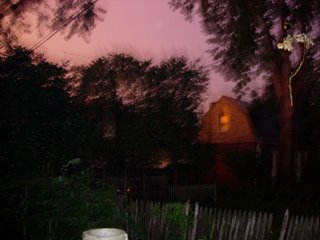
Electricity has somehow become an archaic term. My parents might say that, and so would some others, but for most of us, it's "power", which begas the question of semantics. My power was out for approximately 51 hours., or two days and some change. Blessedly, it was turned back on late last night, so when I came home from work, the lights were shining in my house like a lighthouse guiding me in on the rough seas.
Over the past several days, the world began to look very strange to me. The night of the storm, I saw objects flying through my backyard, huge trees bending in the wind, heard things hitting the building. In terms of damage, my street fared pretty well. One tree in a car, tons of debris, but no big structural damage. Driving to the Royale Wed. night after the storm passed, I quickly realized how huge this thing was. Magnolia was blocked in two places by gigantic felled trees across the road. Even in the dark, I could see the damage to Tower Grove Park. Stoplights were out, and the evening was pitch black, save the lightning bolts spinning across the sky.
The next day, Sarah and I struck out, having sweated like crazy in the heat all night. We needed food, gas, and some air conditioning. We saw billboards torn out of roofs on Gravois, trees that had hit homes, cars srtuck with limbs on top of them. The devastation was huge, and this was a quick storm. Driving became an obstacle course, with asshole drivers weaving in and out of traffic, people not stopping at the broken stoplights, near fisticuffs at the pump. Nothing was open, and that was our first indication. Power was distributed oddly, block by block. On my street, the first night, two houses had power while the rest of us lived in utter darkness.
I went to work to read the paper, to check out info. online. There it was "State of Emergency", "National Guard", and numbers that amazed me. I realized then, that I really felt like I was without power. I'm fine without the TV. I can even live without my computer and don't mind sweating through the 100 plus temp., but not having quick access to information left me feeling more isolated than I would have guessed.
And then I kept hearing people talk. Everywhere I have been the last few days, "Do you have power?" But the funny thing is, in several situations, especially while I was at work last night, I would hear people say, "I have power and you don't," and a few times, I stopped, thinking they were not talking about electricity, but rather, actual power-- like the power to exert control. And that's what it is. What a funny thing we say.
Despite all the damage, I have seen some of the most interesting things the last few days. During the storm, because it was so hot, everyone on my street was out on their front porches, calling to one another over the rain. As I drove around that night, I saw scores of people out walking with flashlights, pulling debris, checking on people. My whole street has become a one-stop source of information, everyone hanging outside because of the heat. I've heard reports many other places of the same thing: block captains patrolling all night for safety, my neighbor staying on his porch in the pitch black, impromptu block parties to create a street presence in the dark. People opening their homes to friends, local businesses doing what they can. Last night, a bunch of people, prompted by the owner of Tension Head Records, went down to Cherokee to patrol the streets. And then today, despite all the debris in Tower Grove Park, despite the lack of power and local businnes, the Festival of Nations went on as planned in the park... and it was packed.
I like that. I like seeing community sprout up and be felt. I like people pulling together. I like that I have gotten my information for the last several days from word of mouth and from conversation, rather than from a computer. I like that in the darkness, we all have seen something different.
The other day, I told someone I felt like the city had been split in two: the "have's" and "have nots". I was a have not. Today, when I got power, I called everyone I could think of and told them they have somewhere to stay. I've realized a third category in the past few days... I'll call it, "community". Screw the power.

Electricity has somehow become an archaic term. My parents might say that, and so would some others, but for most of us, it's "power", which begas the question of semantics. My power was out for approximately 51 hours., or two days and some change. Blessedly, it was turned back on late last night, so when I came home from work, the lights were shining in my house like a lighthouse guiding me in on the rough seas.
Over the past several days, the world began to look very strange to me. The night of the storm, I saw objects flying through my backyard, huge trees bending in the wind, heard things hitting the building. In terms of damage, my street fared pretty well. One tree in a car, tons of debris, but no big structural damage. Driving to the Royale Wed. night after the storm passed, I quickly realized how huge this thing was. Magnolia was blocked in two places by gigantic felled trees across the road. Even in the dark, I could see the damage to Tower Grove Park. Stoplights were out, and the evening was pitch black, save the lightning bolts spinning across the sky.
The next day, Sarah and I struck out, having sweated like crazy in the heat all night. We needed food, gas, and some air conditioning. We saw billboards torn out of roofs on Gravois, trees that had hit homes, cars srtuck with limbs on top of them. The devastation was huge, and this was a quick storm. Driving became an obstacle course, with asshole drivers weaving in and out of traffic, people not stopping at the broken stoplights, near fisticuffs at the pump. Nothing was open, and that was our first indication. Power was distributed oddly, block by block. On my street, the first night, two houses had power while the rest of us lived in utter darkness.
I went to work to read the paper, to check out info. online. There it was "State of Emergency", "National Guard", and numbers that amazed me. I realized then, that I really felt like I was without power. I'm fine without the TV. I can even live without my computer and don't mind sweating through the 100 plus temp., but not having quick access to information left me feeling more isolated than I would have guessed.
And then I kept hearing people talk. Everywhere I have been the last few days, "Do you have power?" But the funny thing is, in several situations, especially while I was at work last night, I would hear people say, "I have power and you don't," and a few times, I stopped, thinking they were not talking about electricity, but rather, actual power-- like the power to exert control. And that's what it is. What a funny thing we say.
Despite all the damage, I have seen some of the most interesting things the last few days. During the storm, because it was so hot, everyone on my street was out on their front porches, calling to one another over the rain. As I drove around that night, I saw scores of people out walking with flashlights, pulling debris, checking on people. My whole street has become a one-stop source of information, everyone hanging outside because of the heat. I've heard reports many other places of the same thing: block captains patrolling all night for safety, my neighbor staying on his porch in the pitch black, impromptu block parties to create a street presence in the dark. People opening their homes to friends, local businesses doing what they can. Last night, a bunch of people, prompted by the owner of Tension Head Records, went down to Cherokee to patrol the streets. And then today, despite all the debris in Tower Grove Park, despite the lack of power and local businnes, the Festival of Nations went on as planned in the park... and it was packed.
I like that. I like seeing community sprout up and be felt. I like people pulling together. I like that I have gotten my information for the last several days from word of mouth and from conversation, rather than from a computer. I like that in the darkness, we all have seen something different.
The other day, I told someone I felt like the city had been split in two: the "have's" and "have nots". I was a have not. Today, when I got power, I called everyone I could think of and told them they have somewhere to stay. I've realized a third category in the past few days... I'll call it, "community". Screw the power.
Subscribe to:
Posts (Atom)


 Posts
Posts

